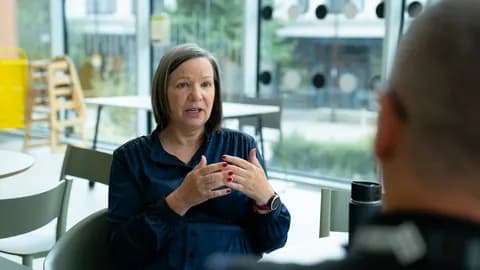
Second interview questions go deeper than the first round's. Expect detailed questions about your past work ("What has been the biggest challenge in your current role, and how did you handle it?"), questions about how you would do this job ("What are the first things you would do?"), and questions about fit, pay and your notice period. The interviewers are often more senior. To prepare, review your first interview, find out who you will meet and in what format, bring new examples, and have questions ready that build on what you learnt in round one.
How a second interview differs from the first
Employers that use a second round have already narrowed the field. Reed, the UK recruiter, says not every employer uses second interviews, but they are usually standard for more competitive roles. Prospects, the UK graduate careers service, says graduate recruiters with large numbers of applications use them most.
| First interview | Second interview | Source | |
|---|---|---|---|
| Purpose | Checks that you match your CV and have the basic skills; builds a shortlist | Compares the shortlist more closely and looks at what separates you from the others | Reed (January 2026), Robert Half Hong Kong |
| Who interviews you | Often someone from HR and your potential manager | Often more senior staff, including people who have the final say; sometimes future co-workers | Hays, Prospects (June 2025), Columbia Career Education |
| Format | Often by phone or video | Often in person; may be a panel or back-to-back meetings over several hours | Columbia, Reed (January 2026) |
| Questions | Your background, career highlights and key skills | More specific to the job; behavioural and situational questions; how you would handle the role's challenges | Hays, Columbia, Indeed (June 2026) |
| Pay and logistics | Usually too early for salary talk | Salary expectations, notice period and start date often come up; Reed calls the later stage "usually the best time for salary chats" | Reed (January 2026), Hays, Prospects (June 2025) |
| Your questions | Questions about the job and the company | More specific questions built on what you learnt in round one | Prospects (June 2025), Hays |
| Competition | A longer list of applicants | A shortlist, usually with "two or three other people in the same position" | Reed (January 2026) |
The interviewer may also come back to your weak spots. Prospects says the employer may want to question you about "one or two areas where you slightly underperformed last time". Hays suggests recalling any question you were asked several times in different ways, since repetition can point to a doubt the interviewer wanted to clear up.
Second interview questions to expect
There is no fixed list, and Prospects warns that the questions are hard to predict. Career services and recruiters give examples like these, and each one is after something specific.
| What it tests | Example question | Source |
|---|---|---|
| Follow-up on round one | "Is there anything you'd like to discuss from your initial interviews?" | Indeed (June 2026) |
| Depth of experience | "What has been the biggest challenge in your current/previous role and how did you handle it?" | Robert Half Hong Kong |
| Ownership | "Tell me about a time you led a project from start to finish." | Prospects (June 2025) |
| Prioritising | "Describe a situation where you had to manage conflicting priorities." | Prospects (June 2025) |
| Judgement | "Have you made an unpopular decision that delivered good results?" | Robert Half Hong Kong |
| The role's real problems | "We're experiencing challenges with ____ right now. How would you approach this?" | Indeed (June 2026) |
| Your plan for the job | "What are the first three things you would do if you land the job?" | Robert Half Hong Kong |
| Working with others | "How do you deal with internal and external stakeholders?" | Robert Half Hong Kong |
| Working with a manager | "What would you do if you disagreed with your manager's decision?" | Prospects (June 2025) |
| Management style | "What management style do you find works best for you?" | Indeed (June 2026) |
| Fit | "What type of work environment do you prefer?" | Indeed (June 2026) |
| Motivation | "What's missing in your current job?" | Indeed (June 2026) |
| Commitment | "What are your career goals in the short and long term?" | Indeed (June 2026) |
| Pay | "What salary would you expect for this role?" | Indeed (June 2026) |
| The close | "Why are you the best fit for this role?" | Indeed (June 2026) |
Most of these are one of two kinds. Behavioural questions ask what you did ("Tell me about a time..."), and hypothetical questions ask what you would do ("Imagine if..."). Google's re:Work guide to structured interviewing, updated March 2026, uses the first to check how you have applied your knowledge and the second to see how you handle problems you have not met before.
For a behavioural question, Indeed Singapore suggests the STAR method: the situation, your task, the action you took and the result. Our STAR method guide shows how to build these answers. For a hypothetical one, talk through your reasoning: re:Work says the interviewer may be judging the thought process you use to explore and solve the problem more than looking for one correct answer.
Use fresh examples where you can. Prospects says that if a question repeats from round one, you should have "additional detail or new things to say", and that the interviewer "is likely to quote your first interview back at you". Have evidence ready for anything you claimed the first time.
How to prepare for a second interview
- Read the invitation closely, then ask about anything it leaves out. Prospects lists what to look for: any tests or exercises, whether the interview is competency- or strength-based, who will interview you, and the topics. Reed says second interviews often follow a different format from the first, so a one-on-one may become a panel. Hays suggests confirming with the recruiter who will conduct the interview.
- Review the first round. Prospects suggests working out which of your answers were best and which were weakest, what you forgot to mention, and which areas were not covered. Hong Kong's Labour Department advises candidates to note what they learnt about the job and the company after each interview "for your reference in your second round of interview".
- Look up the people you will meet. Reed suggests reading the background of any new interviewers, for example on LinkedIn, which can also give you something to talk about.
- Plan your first months in the role. Johnson & Johnson's careers site (April 2021) suggests breaking down a 30-60-90 plan, what you would aim to achieve after 30, 60 and 90 days. Indeed suggests looking at any public work the role has produced, so you can bring ideas and recommendations.
- Have your numbers ready. Hays says the second interview is often when you are asked about your notice period and salary expectations. Johnson & Johnson's advice is to discuss pay with the recruiter or talent acquisition team, not the hiring manager. In Hong Kong, our notice period guide explains how much notice you owe your current employer.
- Prepare a presentation if one is asked for. Reed says a short presentation or case study in the second round is "becoming increasingly common", and suggests asking the recruiter if you are not sure whether to prepare anything.
Questions to ask in a second interview
Prospects says that at this stage the employer "will be surprised if you don't have any queries", and that your questions should be more specific to the job than the first time. Pitch each question to the person you are talking to.
| Ask | Question | Source |
|---|---|---|
| Hiring manager | "What would success look like in the first 6 to 12 months?" | Prospects (June 2025) |
| Hiring manager | "How is performance typically measured and reviewed?" | Prospects (June 2025) |
| Hiring manager | "Do you have any uncertainties about me or my background that I can help address?" | Indeed (June 2026) |
| Senior leader | "Can you tell me how this role contributes to the company's overall success?" | Indeed (June 2026) |
| Future peers | "What is a typical workday like for you?" | Columbia Career Education |
| Future peers | "What are the greatest challenges you face on the job?" | Columbia Career Education |
| HR | "Will there be an orientation or any additional training?" | Columbia Career Education |
| Anyone | "What is the biggest challenge the team is currently facing?" | Reed (January 2026) |
| Anyone, at the end | "What are the next steps after this interview?" | Indeed (June 2026) |
The "uncertainties" question gives you a chance to answer a doubt before you leave, so ask it only if you are ready to reply calmly with an example. Our guide to questions to ask at the end of an interview has more, and the ones to avoid.
Prospects adds that by the end of a second interview it would be unusual if salary and start date had not come up, so it is reasonable to raise them yourself if they have not.
Panels, presentations and super days
Northeastern University's career centre says panel interviews are commonly used in the second or third round, with two to four people asking questions (page checked 15 October 2026). Greet each panellist by name, face the person who asked the question as you start to answer, then look across the whole panel. Prepare a question suited to each person's role.
Some employers, especially in finance, run the second round as a "super day". Columbia's career centre describes several interviews in one day, one-on-one or in a group, usually 30 to 60 minutes each and back to back, sometimes with a presentation or a meal (page checked 15 October 2026). Columbia's advice is to keep your energy up and to write down the name and team of each interviewer so you can thank them afterwards.
After the second interview
Send a thank-you email within 24 hours, as Prospects (June 2025) and Indeed (June 2026) both advise. If you met several people, Columbia suggests a different note to each, mentioning something you discussed with that person.
Reed (January 2026) says decisions after a second interview usually come faster than after a first, "typically" within two to five working days, and that a polite check-in after a week is fine. Prospects (June 2025) suggests following up if you have not heard within the timeframe they gave you, or after five to ten business days.
A second interview is not always the last. Columbia suggests asking whether third-round interviews will be held or a decision will be made straight away, and Johnson & Johnson notes that "there can also be a third (and hopefully final) round". Google is one employer that studied how many interviews it needs. CNBC reported in April 2019 that Google's analysis found "four interviews were enough to predict whether someone should be hired at Google with 86% confidence".
Our guide on what happens after an interview covers the wait, reference checks and when to follow up.
Notes for Hong Kong and Singapore
Robert Half publishes the same advice for both markets: the first round is "commonly used to establish a shortlist", and the second drills into the detail to find out whether you are the right fit for the role and the company. Its Hong Kong and Singapore lists of second interview questions are the same, so the table above applies in both.
In Hong Kong, the Labour Department's Interactive Selective Placement Service suggests confirming the closing date for the selection so you can follow up at the right time, sending a letter of thanks, and not contacting the employer too soon or too often. It also asks you to keep the same contact details and, if you must leave Hong Kong during the process, to tell the employer as soon as possible.
In Singapore, Indeed Singapore's guide (updated 29 September 2025) lists much the same questions as the global lists, including "Is there anything from your first interview that you want to discuss further?", and suggests the STAR method for answering them.
If your first round was a ROUND.1 interview
ROUND.1 is a hiring marketplace for Hong Kong and Singapore. Its first round is one AI video interview, lasting about 20 minutes by default (roles can be shorter), 30 at most. The interview is scored competency by competency, each score is backed by quotes from the transcript, and the same interview is reused for the other roles the candidate chooses.
A company first sees the scored evaluation without the candidate's name or contact details, which open when it shortlists the candidate after the interview. A person at the company decides whom to hire, so any second interview is a conversation with people at the company. The facts are on ROUND.1, explained, and our guide on how to prepare for an AI interview covers the first round.
Frequently asked questions
What are common second interview questions?
Expect more detailed versions of the first round's questions, plus questions about how you would do this particular job. Common ones include: what has been the biggest challenge in your current or previous role and how did you handle it, what are the first things you would do in this role, how would you approach a challenge the team has right now, what management style works best for you, what are your career goals, and what salary do you expect. Indeed's list also includes: is there anything you'd like to discuss from your initial interviews?
What to expect in a second interview?
Expect new and often more senior interviewers, more specific questions, and a closer look at whether you fit the team. Hays says you will most likely meet people at a senior level who have the final say. Reed says the format may change, for example to a panel, and that a short presentation or case study is increasingly common. Salary, notice period and start date often come up. Ask the recruiter beforehand who you will meet and what the format is.
How is a second interview different from the first?
The first interview usually checks that you match your CV and have the basic skills, and it produces a shortlist. The second compares that shortlist more closely. Reed says it focuses more on what separates you from the other applicants, and Robert Half says it drills into the detail to see whether you fit the role and the company. The interviewers are often more senior, the questions more specific, and the meeting is more likely to be in person or with a panel.
How do I prepare for a second interview?
Find out who will interview you and in what format, and whether you need to prepare a test or presentation. Go over your first interview: which answers were weakest, and what you forgot to mention. Prepare new examples, because Prospects says the interviewer may quote your first answers back to you. Have a plan for your first months in the role, your salary expectations and your notice period ready, and prepare questions that build on what you learnt in round one.
What questions should I ask in a second interview?
Ask questions that use what you learnt in the first round and suit the person in front of you. Prospects suggests asking what success would look like in the first 6 to 12 months and about the management style of the person you would report to. Columbia's career centre suggests asking peers what a typical workday is like. Indeed suggests asking whether the interviewer has any uncertainties about your background that you can address. Always ask about the next steps.
Is a second interview a good sign?
Yes, it means the employer wants to know more, but it is not an offer. Prospects says you have clearly impressed the employer to get this far. Reed says a second interview is not a formality and that there are usually two or three other people in the same position. Prospects says to take it just as seriously as the first.
How long after a second interview do you hear back?
It varies by employer, so ask before you leave. Reed's guide, dated 29 January 2026, says decisions after a second interview usually come faster than after the first, typically within two to five working days, and that a polite check-in after a week is fine. Prospects, in June 2025, suggests following up if you have heard nothing within the timeframe you were given, or after five to ten business days.
Sources (13)
- Prospects (Jisc) — How to approach a second interview (June 2025)accessed 2026-10-15
- Hays — What to expect in a second job interviewaccessed 2026-10-15
- Robert Half Hong Kong — Second interview questions to expectaccessed 2026-10-15
- Robert Half Singapore — Second interview questions to expect in Singaporeaccessed 2026-10-15